



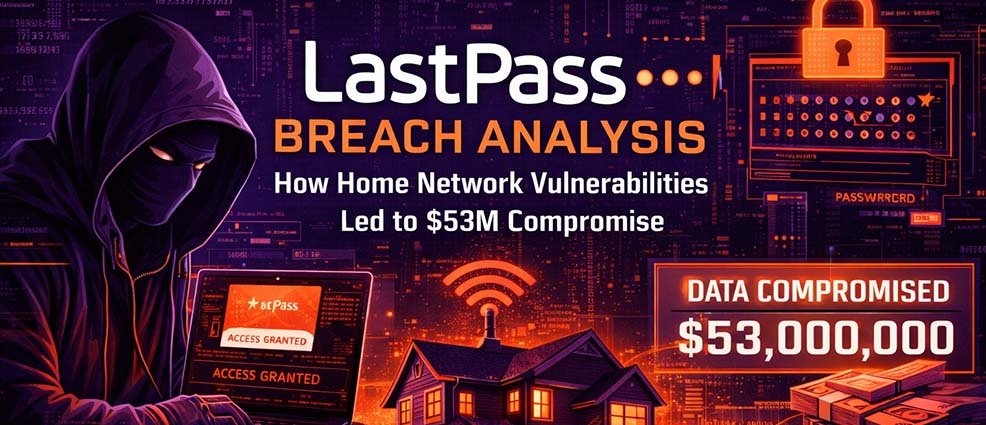
The LastPass security incident of 2022 serves as a stark reminder that cybersecurity is only as strong as its weakest link. What began as a sophisticated attack on a leading password management company ultimately traced back to a surprisingly mundane vulnerability: an unpatched Plex media server running on a DevOps engineer’s home network. This breach, which exposed sensitive vault data affecting millions of users and led to over $53 million in cryptocurrency thefts, demonstrates how personal device security directly impacts enterprise security in our increasingly remote work environment.
The LastPass incident unfolded in multiple phases throughout 2022, but the root cause was traced to a critical vulnerability in a home-based Plex Media Server. The attack leveraged CVE-2020-5741, a remote code execution vulnerability in Plex Media Server that was patched in 2020. However, the DevOps engineer’s home server remained unpatched for over two years, running a version that was approximately 75 versions behind the current release.
The vulnerability allowed attackers to execute arbitrary Python code on the compromised system. Once inside the engineer’s home network, the attackers were able to pivot and gain access to corporate resources, eventually leading to the exfiltration of encrypted password vaults, vault data, and other sensitive information. The breach had far-reaching consequences, with threat actors later using the stolen data to target high-value cryptocurrency wallets, resulting in tens of millions of dollars in losses.
The LastPass incident highlights a critical security challenge in the modern workplace: the blurred lines between personal and professional computing environments. As remote work became standard, employees’ home networks became extensions of corporate infrastructure, often without the same level of security oversight and management.
In this case, the DevOps engineer’s home network contained both personal devices, like the vulnerable Plex server, and systems with access to LastPass’s production environment. The attackers exploited this mixed environment, using the compromised media server as a stepping stone to access more sensitive corporate resources.
The Plex vulnerability itself was particularly dangerous because it allowed for remote code execution without authentication. Attackers could scan for vulnerable Plex servers exposed to the internet and immediately gain a foothold in the target network. The fact that this vulnerability had been known and patched for over two years made the compromise entirely preventable with proper patch management practices.
The breach timeline reveals how a single unpatched device can lead to catastrophic consequences:
Initial Compromise: Attackers exploited the unpatched Plex server to gain initial access to the engineer’s home network.
Lateral Movement: Using the compromised home network as a base, attackers pivoted to access the engineer’s corporate credentials and systems.
Corporate Infiltration: With corporate access established, the attackers spent months moving laterally through LastPass’s infrastructure, eventually gaining access to backup systems containing encrypted vault data.
Data Exfiltration: The attackers successfully exfiltrated encrypted password vaults and associated metadata, affecting millions of LastPass users.
Post-Breach Exploitation: Threat actors used the stolen data to conduct targeted attacks against high-value cryptocurrency users, resulting in over $53 million in documented losses.
The financial impact extended beyond direct cryptocurrency thefts. LastPass faced significant reputational damage, regulatory scrutiny, and the costs associated with incident response, system hardening, and customer communications. The breach also highlighted the challenges password managers face in balancing security with usability when protecting sensitive user data.
CVE-2020-5741 is a directory traversal and remote code execution vulnerability affecting Plex Media Server versions prior to 1.19.1.2630. The vulnerability has a CVSS v3.1 base score of 9.8 (Critical), indicating maximum severity across multiple impact categories.
The flaw allowed unauthenticated attackers to execute arbitrary Python code on vulnerable Plex servers through specially crafted HTTP requests. This type of vulnerability is particularly dangerous because it provides immediate, high-level access to the target system without requiring any user interaction or authentication.
What made this vulnerability especially impactful in the LastPass context was its ease of exploitation and the fact that many Plex servers are configured to be accessible from the internet to enable remote media streaming. This internet exposure, combined with the lack of authentication requirements for exploitation, made vulnerable servers easy targets for automated scanning and exploitation.
The vulnerability was responsibly disclosed and patched by Plex in 2020, with clear documentation about the security risk. However, like many home users, the LastPass engineer failed to maintain current software versions, leaving the system vulnerable for over two years.
The LastPass incident exemplifies a fundamental challenge in modern cybersecurity: securing the expanded attack surface created by remote work. Traditional corporate security models relied on clear perimeters between trusted internal networks and untrusted external environments. Remote work has collapsed these boundaries, making home networks and personal devices critical components of enterprise security.
Several factors contributed to this security gap in the LastPass incident:
Lack of Visibility: IT teams often have limited visibility into employees’ home networks and personal devices that may have corporate access.
Inconsistent Patch Management: Home devices typically lack the centralized patch management systems used in corporate environments, leading to outdated software with known vulnerabilities.
Mixed-Use Environments: Home networks often contain a mixture of personal and work devices, creating complex trust relationships and potential attack paths.
Insufficient Monitoring: Home networks rarely have the security monitoring and incident detection capabilities present in corporate environments.
The LastPass breach could have been prevented with proper visibility and management of home network devices. 4Remote provides comprehensive solutions that address the exact vulnerabilities that led to this costly incident:
4Remote automatically discovers and inventories all devices on home networks, including media servers, IoT devices, and other systems that might be overlooked by traditional IT management tools. In the LastPass scenario, 4Remote would have immediately identified the Plex server and flagged it as a potential security risk requiring attention.
The platform provides detailed device information including hardware specifications, operating system versions, installed software, and network configuration. This comprehensive visibility ensures that no device goes unmanaged, preventing the kind of oversight that allowed the vulnerable Plex server to remain unpatched for over two years.
4Remote continuously monitors devices for known vulnerabilities, including CVEs like CVE-2020-5741. The platform would have immediately flagged the unpatched Plex server as critically vulnerable and provided specific remediation guidance to address the risk.
Key vulnerability management features include:
Real-time CVE Monitoring: Automatic detection of vulnerable software versions and immediate alerting for critical security issues.
Prioritized Risk Assessment: Intelligent prioritization of vulnerabilities based on exploitability, potential impact, and current threat landscape.
Automated Remediation Guidance: Step-by-step instructions for patching and securing vulnerable systems, making it easy for non-technical users to maintain security.
The LastPass incident occurred because a critical security patch was never applied. 4Remote addresses this challenge through intelligent patch management that makes it easy for remote workers to keep their systems secure:
Automated Patch Detection: The platform automatically identifies available security updates for all monitored devices and software.
Risk-Based Prioritization: Critical security patches are prioritized and highlighted, ensuring that the most important updates receive immediate attention.
User-Friendly Notifications: Clear, actionable notifications help users understand which updates are critical and provide guidance on safe patching practices.
4Remote provides continuous monitoring of home network security posture, identifying potential attack vectors and security misconfigurations that could be exploited by threat actors:
Exposure Assessment: Identification of internet-facing services and devices that could be targeted by attackers.
Configuration Analysis: Assessment of device security settings and recommendations for hardening configurations.
Anomaly Detection: Monitoring for unusual network activity that might indicate a compromise or attack in progress.
The LastPass incident provides several key lessons for organizations and remote workers:
Maintain Current Software Versions: Regular patching is critical, especially for internet-facing services and devices with known vulnerabilities.
Implement Network Segmentation: Separate personal and work devices on different network segments to limit potential attack paths.
Monitor Home Network Devices: Use tools like 4Remote to maintain visibility and control over all devices that could impact security.
Establish Clear Security Policies: Organizations should provide clear guidelines and tools for securing home work environments.
Regular Security Assessments: Periodic evaluation of home network security posture to identify and address potential vulnerabilities.
The LastPass breach serves as a powerful reminder that in our interconnected world, personal device security directly impacts enterprise security. A single unpatched Plex server in a DevOps engineer’s home network became the entry point for one of the most significant password manager breaches in history, ultimately leading to over $53 million in cryptocurrency thefts and affecting millions of users worldwide.
This incident underscores the critical importance of comprehensive security management that extends beyond traditional corporate boundaries. As remote work continues to be a permanent fixture of the modern workplace, organizations must implement solutions that provide visibility and control over the expanded attack surface created by distributed work environments.
4Remote addresses these challenges by providing the tools and visibility needed to secure home networks and prevent the kind of oversight that enabled the LastPass breach. Through comprehensive device discovery, proactive vulnerability management, and intelligent patch management, 4Remote helps organizations and remote workers maintain security posture across all environments.
The LastPass incident was entirely preventable with proper security practices and tools. By learning from this costly mistake and implementing comprehensive security solutions like 4Remote, organizations can protect themselves from similar breaches and maintain security in an increasingly distributed work environment.