



The modern attack surface is no longer defined by the corporate perimeter. It is shaped by people, devices, software and networks that operate well beyond traditional enterprise controls. Remote working, contractor access, cloud-first delivery models and unmanaged home or third-party networks have fundamentally changed what “knowing your environment” really means.
Industry guidance consistently highlights this shift. NIST explicitly recognises that organisational assets now extend into external, third-party and personally owned environments, all of which must be considered part of the system risk boundary rather than exceptions to it (NIST SP 800-53 Rev. 5; NIST SP 800-207).
Attack surface expansion is not inherently a tooling problem; it is a visibility problem. Most material security incidents still trace back to assets that were unknown, poorly classified or incorrectly assumed to be managed. The Verizon Data Breach Investigations Report (DBIR) continues to show that asset mismanagement, unpatched systems and unknown exposure points remain recurring contributors to breaches, particularly in distributed workforces.
Asset visibility is therefore the foundational control. Without an accurate, continuously updated view of assets, security teams cannot reliably assess exposure, prioritise vulnerabilities or enforce access policies. This challenge is amplified in remote and unmanaged networks, where traditional discovery methods rely on network adjacency, VPN connectivity or static inventories that quickly become obsolete.
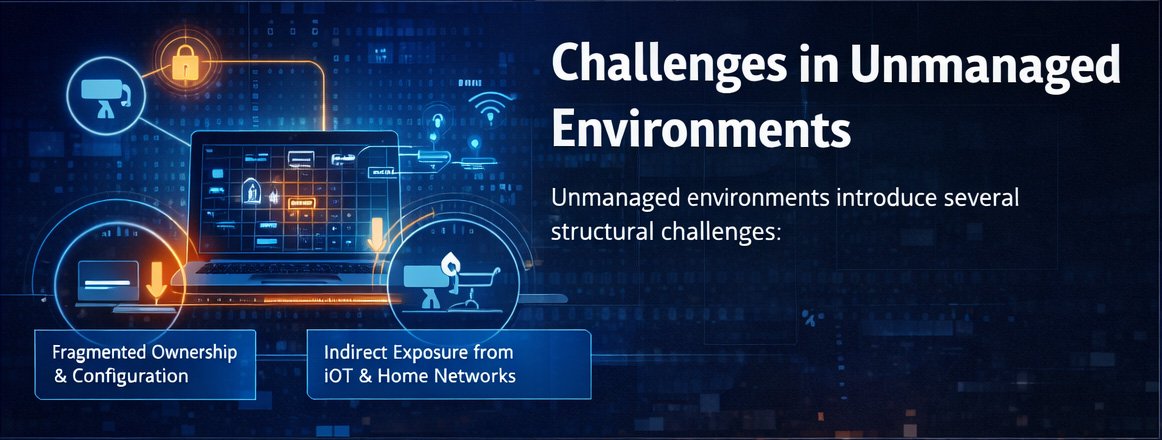
Unmanaged environments introduce several structural challenges:
Gartner has consistently highlighted this gap, identifying Cybersecurity Asset Attack Surface Management (CAASM) as a response to the failure of legacy asset management approaches to keep pace with hybrid and remote operating models. CAASM emphasises continuous discovery, correlation and validation of assets across environments, rather than reliance on declared inventories or point-in-time scans.
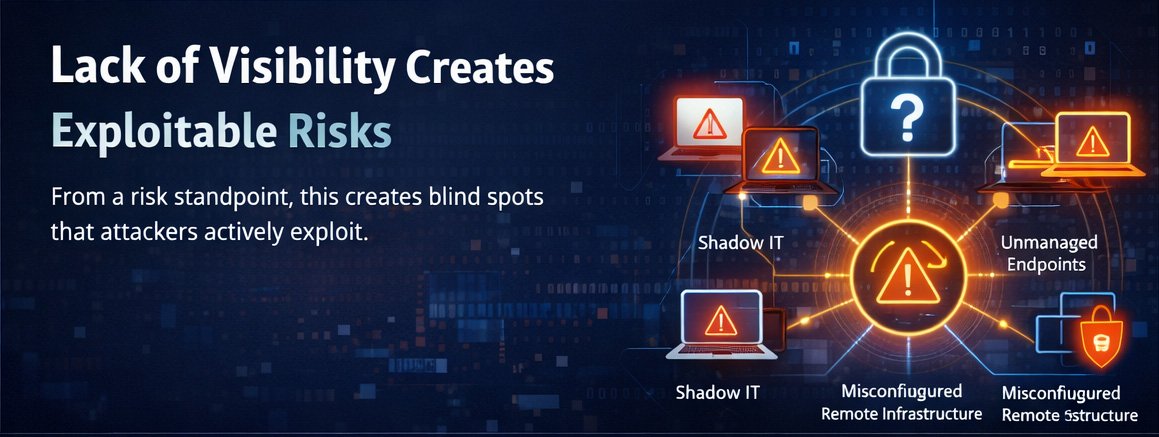
From a risk standpoint, this lack of visibility creates conditions attackers exploit deliberately. Shadow IT, unmanaged endpoints and misconfigured remote infrastructure frequently act as initial access vectors. Without visibility, these assets are excluded from vulnerability prioritisation, detection logic and access decisions until after compromise.
Modern attack surface management therefore requires continuous, context-aware discovery. Assets must be identified regardless of ownership, location or network type and linked to their security posture in near real time. This aligns directly with Zero Trust principles, where trust is not inferred from network position but derived from verified asset and posture data (NIST SP 800-207).
4Remote complements this approach by focusing visibility on remote and unmanaged environments that sit outside traditional enterprise tooling. By discovering assets as they actually exist across distributed networks, and correlating them with vulnerability and risk context, it supports CAASM-aligned practices and reduces reliance on assumptions or manual reconciliation across tools .
For CISOs, the objective is not absolute control over every environment, but the removal of uncertainty. Accurate asset visibility underpins effective vulnerability management, informed access decisions and defensible risk reporting. In remote and unmanaged networks, visibility is not an operational convenience – it is a primary security control.
References