



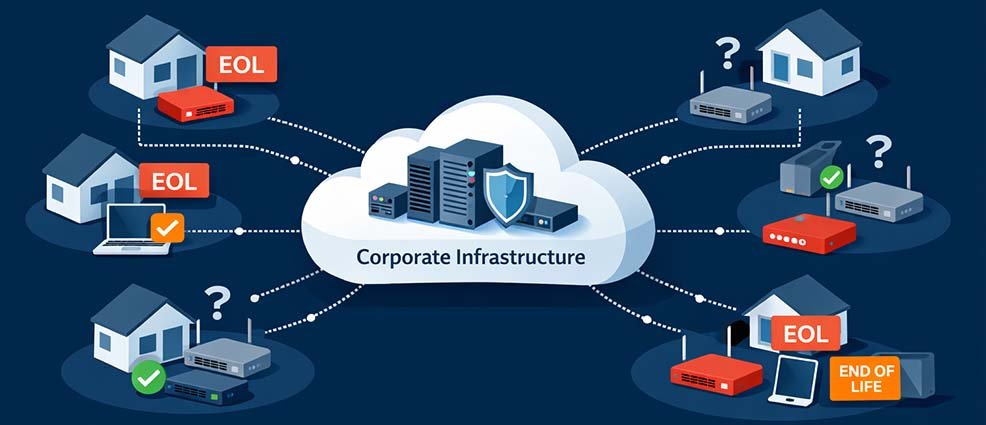
The Cybersecurity and Infrastructure Security Agency (CISA) recently issued a critical directive ordering federal agencies to identify and replace end-of-life (EOL) network edge devices following a series of high-profile breaches targeting outdated infrastructure. This directive highlights a growing vulnerability that extends far beyond government networks. it’s a wake-up call for every enterprise managing distributed workforces and remote operations.
CISA’s directive specifically targets network edge devices that have reached end-of-life status, meaning manufacturers no longer provide security patches or updates. According to the TechRadar Pro report, this action comes in response to threat actors actively exploiting vulnerabilities in these unpatched devices to gain initial access to networks.
The directive requires federal agencies to complete inventories of their edge infrastructure and develop replacement timelines for any EOL equipment. While aimed at government entities, the security principle applies universally: you cannot secure devices that are no longer receiving security updates, and you cannot replace devices you don’t know exist.
Internal link opportunity: Link “distributed workforces” to your Network Edition or Enterprise Edition product page
Here’s where the problem compounds for modern enterprises. When employees work from home networks, traditional IT asset management tools lose visibility. Your security team might have complete oversight of corporate office infrastructure, but what about the aging router in your CFO’s home office? Or the EOL network switch supporting your VP of Engineering’s home lab?
The CISA directive assumes agencies know what devices exist on their networks. For organizations with distributed workforces, that assumption breaks down at the remote edge. You’re not just managing corporate data centers and office locations anymore, you’re responsible for security across hundreds or thousands of home networks where your employees access company resources.
Internal link opportunity: Link “remote edge” to a Knowledge Hub article about remote work security challenges
The federal government’s urgency around EOL device replacement reflects a broader trend in threat actor behavior. Attackers are specifically targeting outdated edge infrastructure because:
For CISOs managing Zero Trust initiatives or working toward compliance frameworks like NIST CSF 2.0, this creates a critical gap. You cannot implement proper access controls, segmentation, or continuous verification when significant portions of your network edge remain invisible to security tools.
Find out about Zero Trust Bundles
CISA’s directive starts with a fundamental requirement: inventory your edge devices. For federal agencies with centralized, managed infrastructure, this is challenging but achievable. For enterprises with distributed workforces, it requires a fundamentally different approach.
Traditional network scanning tools and endpoint agents cannot discover devices on employee home networks. That aging router, the unmanaged switch, the IoT security camera on the same network as corporate laptops, these devices exist outside the visibility of conventional enterprise security tools.
This is precisely the gap between having a security policy and being able to enforce it. Your organization might have clear requirements about EOL device replacement, but without comprehensive discovery across distributed environments, those policies remain aspirational.
4Remote’s platform solves the core problem highlighted by CISA’s directive: comprehensive discovery and cataloging of network edge devices across distributed environments, including remote worker home networks.
Automatic EOL Device Identification
4Remote continuously discovers and catalogs all devices on remote networks, including routers, switches, access points, and other edge infrastructure. The platform automatically identifies device make, model, and firmware version, then cross-references this information against manufacturer end-of-life databases to flag devices that no longer receive security updates.
Unlike traditional tools that stop at the corporate perimeter, 4Remote provides security teams with visibility into the actual network infrastructure supporting remote workers. This includes:
Actionable Intelligence for Security Teams
Discovery alone isn’t enough, security teams need prioritized, actionable information. 4Remote provides:
CISA’s directive to federal agencies reflects a security best practice that every organization should adopt: proactive identification and replacement of end-of-life edge devices. The challenge isn’t creating the policy, it’s implementing it across distributed environments where visibility has traditionally been limited.
4Remote enables security teams to:
This transforms EOL device management from a periodic audit exercise into a continuous security capability.
CISA doesn’t issue directives without cause. The focus on EOL edge devices reflects current threat actor tactics and recent breach patterns. For enterprises, this represents both a warning and an opportunity, a warning about a specific attack vector, and an opportunity to address visibility gaps before they become breach headlines.
The remote work transformation permanently changed enterprise network architecture. Security strategies must evolve to match that reality. CISA’s directive to federal agencies applies equally to private sector organizations managing distributed workforces: you must know what devices exist on your networks, and you must systematically address devices that can no longer be secured through patches and updates.
If your organization manages remote workers, the question isn’t whether you have EOL devices on remote networks—the question is whether you know where they are and have a plan to address them.
4Remote provides the visibility and intelligence security teams need to implement EOL device management across distributed environments. By automatically discovering, cataloging, and assessing edge devices on remote networks, the platform enables security teams to move from reactive incident response to proactive risk management.